Exhibition
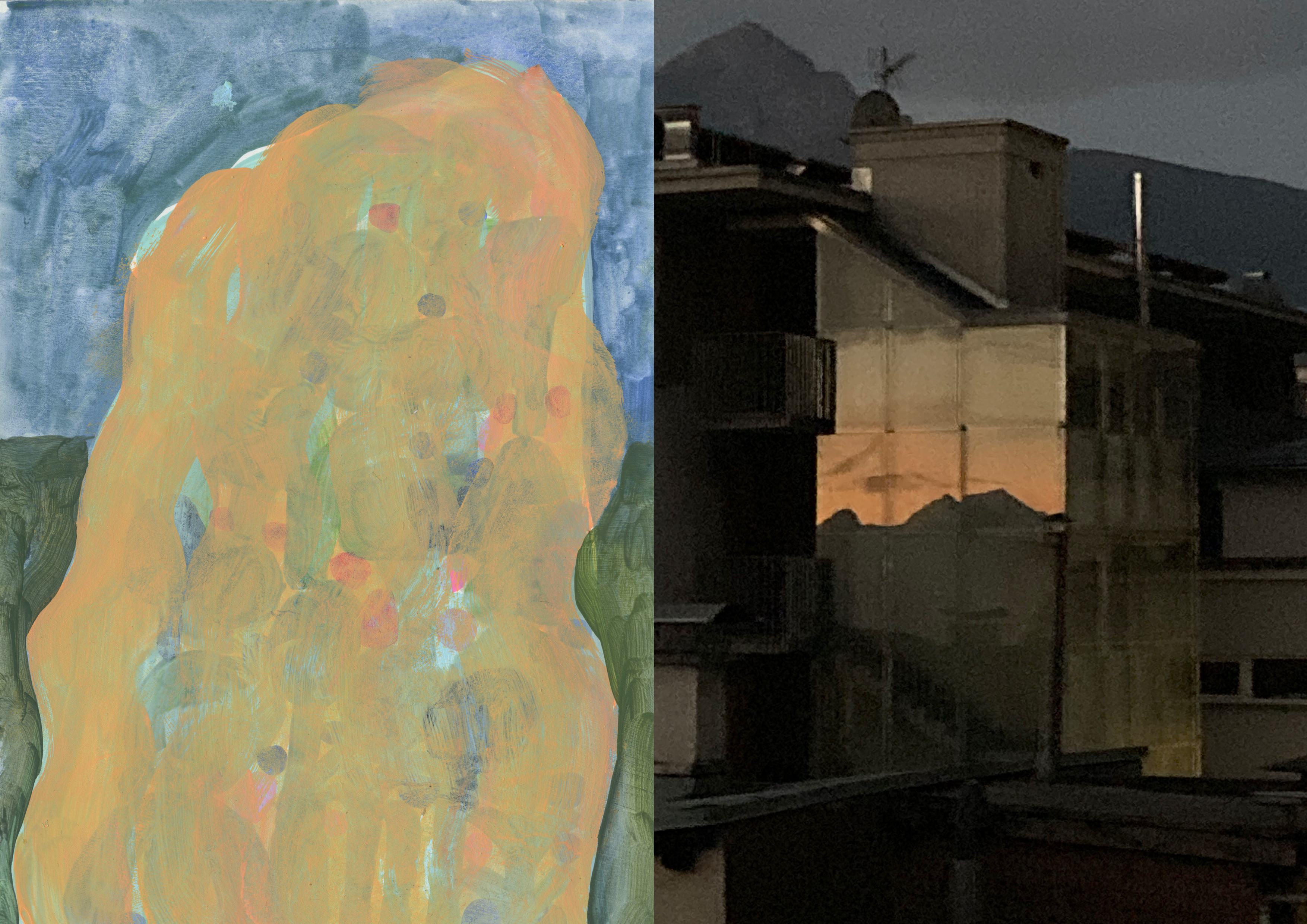
Flirt brings together a selection of works by Innsbruck-based artists Lea Abendstein and Isabel Peterhans and provides insights into their artistic interaction. Rather than presenting the results of a clearly defined collaboration, the exhibition sees itself as a means of rapprochement—as part of an open-ended process. In working toward the exhibition, the two artists unexpectedly discovered many points of contact in their working methods. An intensive exchange of emails accompanied this dialogue. Art appears here as a relational practice, exhibiting as a method that makes the boundaries of one's own self and who one believes oneself to be porous. Who are we if we do not engage with each other, if we are not connected? How can we succeed in building a deeper relationship with the world? Connection, writes Kae Tempest, requires fully accepting and experiencing the present moment. Creativity can be a way “to achieve connection and enter into a space of greater connectedness with those who share the moment with you.”[1]
In the entrance area of the exhibition, visitors are invited to engage in this encounter—to enter, penetrate, and shed layer by layer. The eye is drawn to bright lengths of fabric that have been dyed by the artists using natural materials. Inscribed with the artists' key feminist and philosophical readings and supplemented by excerpts from email correspondence, fictional flirtatious conversations, and a list of self-attributions and attributions by others, the layers of fabric hang one behind the other, forming a passageway. The text fragments resemble blurred tattoos on layers of skin and refer to the lasting feeling of finding oneself in another person's words and carrying them with oneself.
If the textile assemblage Seamless is not traversed immediately at the beginning, the tour unfolds along a chronological thread. This leads from the convergence of artistic practices to a consolidation of their creative interconnectedness and finally to an arrival. However, this arrival does not mark an end, but rather opens up a space for intimacy and vulnerability in which the artists' desire for a more communal existence becomes tangible.
In the hallway to the right of the entrance, the artists display collages in which they reflect on processes of ordering, layering, and reassembling. For the series Heimsuche (Home Visit), Isabel Peterhans arranges leftovers from the studio—a recurring practice in the work of both artists—into organic forms, thereby transforming them into a temporary order. Despite their apparent stagnation, the intricate botanical motifs appear as witnesses to interconnections that elude our perception. Mirroring this, the photo collages entitled Intermezzo on the opposite wall create new connections. Lea Abendstein cuts out the outlines of her body in self-portraits—leaving behind a void, as a question about alternative spaces for action.
In the main room, paintings by Isabel Peterhans and photographs by Lea Abendstein enter into an associative dialogue. Abendstein's photographs come from a constantly growing archive of cell phone images in which she zooms in on details of her surroundings: patterns, blurred plays of light, atmospheric images of everyday life. They encounter Peterhans' figurative to abstract paintings, which—inspired by texts on natural philosophy—visualize inner processes triggered by perceptions. In Ich sehe was, was du nicht siehst (I see something you don't see), a new dimension emerges in the connection between the artists: their relationship to the world around them.
The processual approach ultimately culminates in the joint room installation Rest to Gather in the studio, which is dedicated to the theme of ‘home’ as a place of (self-) encounter and can be understood as a critical commentary on a society in which people live in a state of inner disconnection – from themselves, from nature, and from the social fabric. Carpets woven from textile remnants by Abendstein meet banners by Peterhans, for which she has composed pieces of fabric into reduced forms. Projected images of tables documenting moments of coming together complement the textile works. Feminine-connoted relationships such as closeness, togetherness, and care emerge here as essential dimensions of artistic practice and social coexistence. Visitors are invited to take off their shoes, linger to the sounds of Ö1 radio, and participate in the collective knitting project. Amidst the softness of the textiles, the opportunity arises to reflect together on how vibrant places of connectedness can be created.
The suggested tour ends with a (second) walk through the textile assemblage. Here, fragments of text invite us to engage in conversation across boundaries—across the lines that separate spaces and people, and about the possibility of a critical reassessment of our diverse world relations. The exhibition was invited by Nadja Ayoub, former director of Kunstraum Schwaz, and curated by her successor, Karin Pernegger.
Text: Veronika Riedl
Lea Abendstein studied photography and fine arts at the Academy of Fine Arts Vienna. She works as an art educator at bilding, an art and architecture workshop for children and young people, and since 2021 as a freelance artist and, since 2025, also as a shiatsu practitioner in Tyrol and Vienna. She is part of the feminist soft punk band kill-the band and enjoys eating spinach. Her work has been awarded the Wolf Suschitzky Prize for Photography and the Josef Franz Würlinger Prize of the City of Innsbruck.
lea.abendstein.net
Isabel Peterhans studied visual communication with a focus on illustration at the Lucerne University of Applied Sciences and Arts – Design Art Film and at the Bezalel Academy of Arts and Design in Jerusalem. She has been a freelance illustrator, artist, and art educator since 2012 and has lived with her family in Innsbruck since 2018. Her work appears in national and international magazines and books.
www.isabelpeterhans.ch
[1] Kae Tempest, Verbundensein. Suhrkamp, 2021, 15f.
image © Lea Abendstein Isabel Peterhans
Anhören